
STUDIO HABITS
Studio Habits of Mind
The Real Benefits of Visual Arts Education
Originally written by Kimberly M. Sheridan, Shirley Veenema, Ellen Winner and Lois Hetland, this classic framework outlines eight studio habits of mind that lead to successful art education environments. In educating Lower School Students at the Bear Creek School, each of these different studio habits are practiced regularly.
Develop Craft
Students regularly learn to develop their Art Skills, Technique and Studio Practice in ways that benefit them individually and as a group.
Habit #1
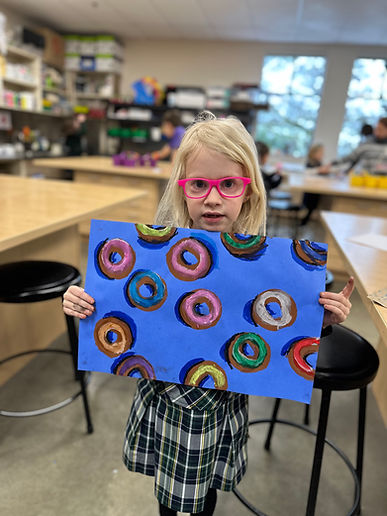
Photo: Grade 1 students learned about form and shape in this creative donut painting inspired by the work of Wayne Thiebaud.
Engage & Persist
Habit #2
Students who know how to persevere and work hard for intrinsic reasons can thrive, both in the Studio and in life.
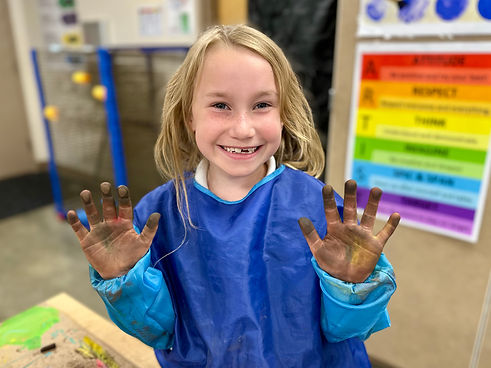
Photo: Grade 2 students learned how to create with oil and chalk pastel, persevering through a difficult medium to create enchanting sunflower compositions.
Envision
Teaching students to observe and envision in the classroom remains foundational for understanding how to conceptualize their work and communicate to others successfully.
Habit #3
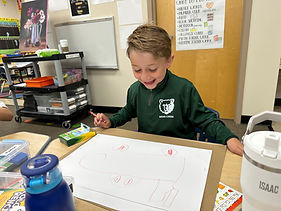
Photo: Kindergarten students successfully envisioned what they looked like in their Imagination Self Portraits, including this young athlete.


Express
Habit #4
Expression does not mean an unruly display of feeling. Instead, students must develop an alertness to want to create expression in their art and an inclination to actively pursue meaning in their art.
Photo: Grade 2 students explored expression by choosing their favorite colors and words to describe themselves within these Crayon Relief Portraits.
Observe
To Observe is to actually see and not merely look at the world around us. For young students, breaking complex drawings into smaller shapes helps them to understand they can grow in their skills and trains them to look differently at the objects they want to represent.
Habit #5
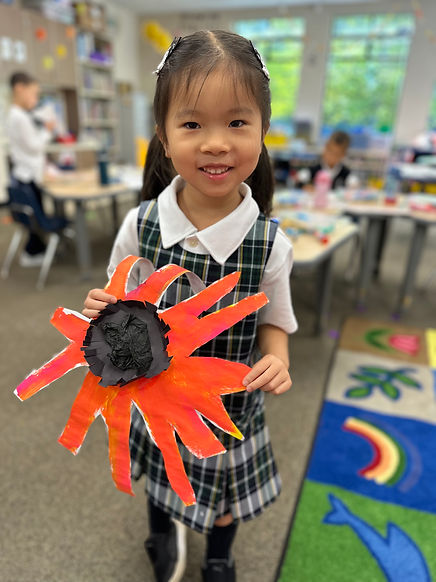
Photo: Kindergarten Students studied what Poppies looked like, both through hands on examples and the iconic work of Georgia O'Keeffe to make their own Poppies.

Reflect
Habit #6
This key component of the Art Studio helps students become independent and autonomous. By training students to step back and reflect, teachers can help their students internalize the artistic process and grow from it.
Photo: Grade 4 Students stepped back from their compositions, helping each other to reflect on what was working and how to improve their drawings further.
Stretch & Explore
The habit of mind Stretch & Explore is all about teaching students to push at constraints to find an adaptive solution.
“For artists, mistakes are opportunities – they lead to problem-solving as well as to something more at the core of creativity – problem-finding (Getzels & Csikszentmihalyic, 1976) pg. 77).”
Playing, experimenting and inventing are all foundational here.
Habit #7
Photo: Grade 4 Students experimented with color mixing and color harmony within their abstract compositions.

Understand Art Worlds
Habit #8
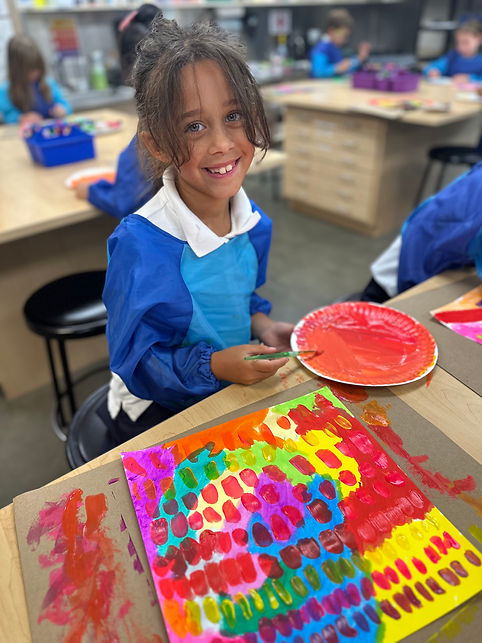
I love showing art from many different artists, times and contexts. Nearly every lesson in my class begins with showing students a piece of art from a different artist. Opening their eyes to larger communities all within the context of another artists viewpoint allows for students to feel the depth, breadth and beauty of their own art.
Photo: Grade 1 Students studied the work of Alma Thomas to influence their creativity.
Art Advocacy Project
Collaboration & Community in the Art Studio
Grade 4 students learned to Stretch and Explore by collaborating in groups to design, plan and create their own giant paper flowers to decorate a collaborative Art Installation for our community-wide Art Show on May 28th. Students created their flowers, solved problems, tried new materials and successfully created a large-scale paper flowers.
